
What is it about?
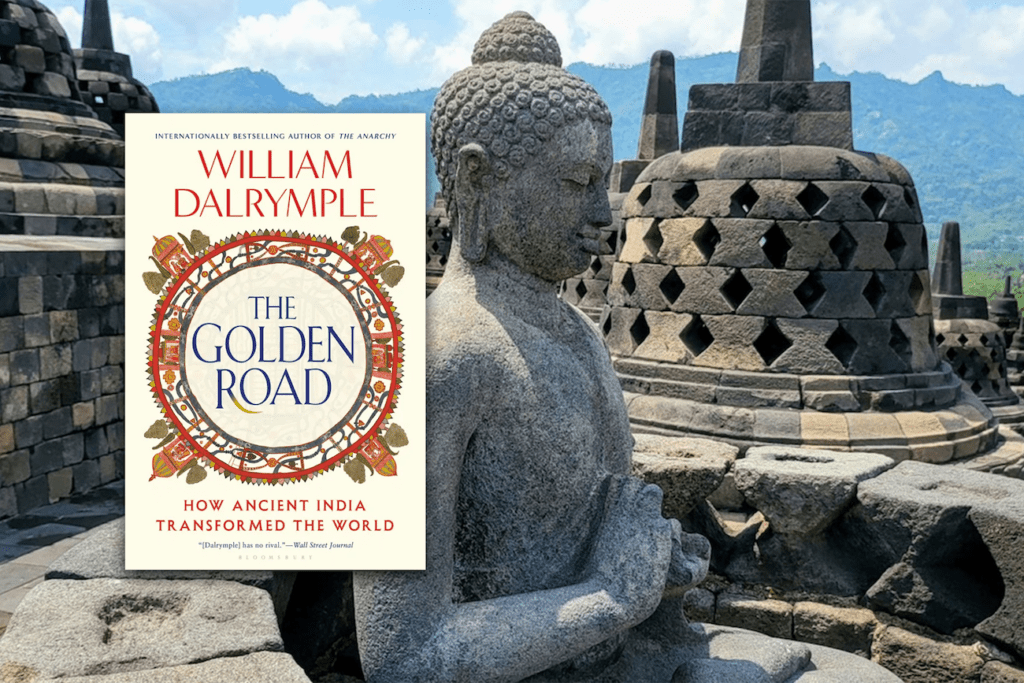
In The Golden Road: How Ancient India Transformed the World, William Dalrymple undertakes an ambitious project: to reframe the ancient history of South Asia not as a periphery to Eurasian affairs but as its vibrant centre. Rather than following the familiar narrative arc dominated by Greece, Rome, or China, Dalrymple maps a largely overlooked era — roughly 250 BCE to 1200 CE — during which Indian ideas, religions, art, science, and commerce radiated outward across the continent and beyond. At the heart of his argument is the notion of a
maritime and cultural network he terms the “Golden Road,” a series of Indian-anchored trade and intellectual corridors stretching from the Red Sea to the Pacific that, in many ways, predates the famed Silk Road, which Dalrymple has often called a 19th century construct.
Dalrymple’s narrative begins with India’s rich trade links — from Roman luxury demand for Indian cloth and spices to South Asian merchants harnessing monsoon winds to reach Southeast Asia and China. But this is not just about commerce. Through vivid detail and extensive research, the book traces the spread of Buddhism into East Asia, the imprint of Sanskrit and Hindu culture across Southeast Asian polities, and India’s foundational contributions to mathematics, astronomy, and philosophy. Along the way, Dalrymple’s storytelling marries scholarly depth with accessible prose, positioning the subcontinent as a fulcrum of ancient global interchange
What we loved!
Dalrymple excels at synthesising a vast swathe of history into a coherent and engaging narrative — a rare feat given the temporal and geographic breadth involved. His thesis that India was a central node of cultural, religious, and intellectual exchange across Eurasia is backed by both archaeological evidence and historical texts, and it breathes new life into debates about ancient globalisation. The book’s maritime worldbuilding is mind expanding. You are constantly traveling with him: to ruins in Afghanisthan threatened by Chinese infrastructure projects to the immense temples of Kanchipuram and Angkor, and there is some new information always popping up. The chapters dealing with the spread of Buddhism under Empress Wu Zetian and the cosmopolitan milieu of Buddhist South Asia capture a world that feels both foreign and vividly connected to our own. Dalrymple’s prose remains accessible throughout, balancing scholarly rigor with narrative verve that keeps complex themes from becoming dry.
What could be better?
Despite its strengths, The Golden Road occasionally feels uneven in scope. Some regions receive meticulous attention (e.g., Buddhist transmission into China), while others — notably parts of Southeast Asia such as the Malay Peninsula — lamentably receive less exploration, creating gaps in the otherwise panoramic view. The Mathematics chapters (the last two) are not really Dalrymple’s areas of comfort one feels. This part of the book leans heavily on existing academic work rather than original argumentation, making portions feel like a secondary synthesis rather than a fresh analytical breakthrough.
Critics have also noted that the framing of ancient India’s influence, while persuasive, risks being received as political affirmation rather than purely historical insight. And at the end of 2025 the enthusiasm shown by the few Indian Babus I have heard speak of the book, does worry one. Hopefully they see it not as proof for Indian Exceptionalism and rather another point marked for Pluralism.
Why You Should Read It
Read The Golden Road if you want to rethink world history through a lens that centres South Asia’s intellectual and cultural footprint. Dalrymple challenges the default Sinocentric or Eurocentric periodisation of antiquity by showing how Indian trade networks, religious movements, mathematical innovations, and linguistic exchanges forged a shared civilisational terrain across Asia.
For readers interested in ancient religions, maritime history, or the deep roots of globalisation long before the modern era, this book offers lush storytelling grounded in serious scholarship. Unlike brittle textbooks, it offers context, colour, and human resonance — transporting you from the marketplaces of Muziris to the grand temples of Angkor and the monastic seats of Nalanda. Whether you’re a student of history or a curious reader fascinated by the interconnectedness of past worlds, Dalrymple’s account is both illuminating and richly rewarding.
Score: A solid 8.9/10
 Babel School of Languages