
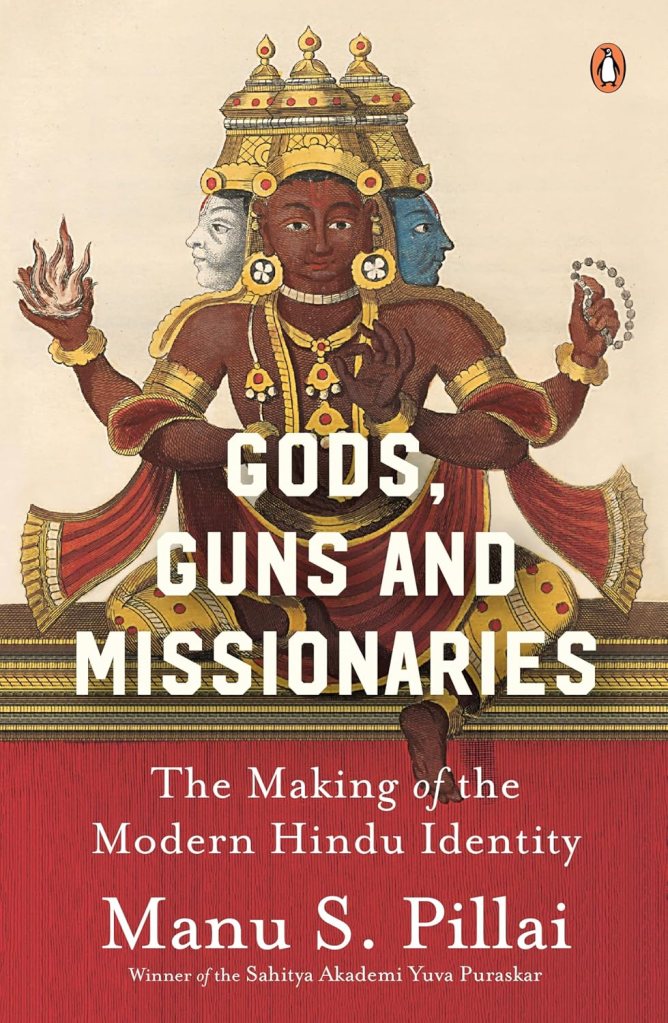
What is it about?
Manu Pillai has a particular talent: he can take a subject that is constantly weaponised in public discourse and return it to the level of history — the slow churn of influence, encounter, misunderstanding, adaptation. Gods, Guns and Missionaries is his clearest demonstration of that talent. The book tracks how “Hindu identity,” which we often treat as ancient and fixed, is in fact a modern construction shaped by centuries of friction: with missionaries, colonial administrators, court politics, and internal reform movements. Pillai doesn’t present Hinduism as a unified tradition marching through time; he shows how it hardened into something recognisable only when it collided with other forces.
The pleasure of the book lies in Pillai’s steady intellect. There is no sermonising. And dollops of intellectural rigour and courage. The book is a patient reconstruction of how ideas mutate when they are pushed, pressured, and misread. Pillai moves between courts, coastal trading towns, missionary reports, royal correspondence, and political theatre where status, faith, and power were constantly renegotiated. He brings out the absurdities, the ironies, the accidents — all the tiny contingencies that shape large identities. It feels like history written the way it should be: alert to nuance, resistant to simplification, and superbly aware of the stakes.
What really works!
The book’s strength is its clarity. Pillai never forces a single narrative; instead, he assembles a set of encounters that reveal how fluid religious identity has been. He challenges the new rhetoric on hinduism, shaped by pressures of modernity. His portraits — of missionaries convinced they were saving souls and also scheming up the best possible ways to denounce the local gods or of local elites trying to hold on to status, of reformers reshaping ritual to meet colonial scrutiny — are sharp and unsentimental and could have made the late Edward Said proud. He restores agency to those who are often flattened into stereotypes, and he does it without taking sides like a superstar funambulist. The writing is elegant, unhurried, and confident. Most importantly, the book resists both nationalist myth-making and self-flagellating liberalism. It simply tells the story, and trusts the reader to think.
What could be better
Honestly? Very little. The broad sweep occasionally works against Pillai, if we really want to nitpick. Some chapters feel like glimpses into larger stories that deserved more time, and a few transitions read more like curated essays than parts of a continuous argument. That could also be because we want more. Certain regions and periods -especially the Guns of the title- are important to the scheme of the book- but those are topics others have dealt with to death. Manu’s strengths are in full display in the first three quarters of the book where Gods and Missionaries rule the pages. Definitely there is nothing in the book that could ever be said as incorrect or careless — the issue is scale. With so many threads in play, the core thesis sometimes loosens.
Why should you read it?
Because it brings adult intelligence into a space dominated by noise. If you want to understand how identities are built — not mythically “born” — this book lays out the mechanics without drama. Pillai is that rare historian who can be honest without being cynical and clear without being simplistic. The book is an antidote to both grandiose cultural pride and lazy dismissal; it shows how the past actually works, how ideas migrate, how rituals shift under pressure, how people adapt when confronted with unfamiliar power. If you want to think about Hinduism, or the shaping of any religion, seriously, this is the kind of history that helps.
Score: 9.1 / 10
 Babel School of Languages